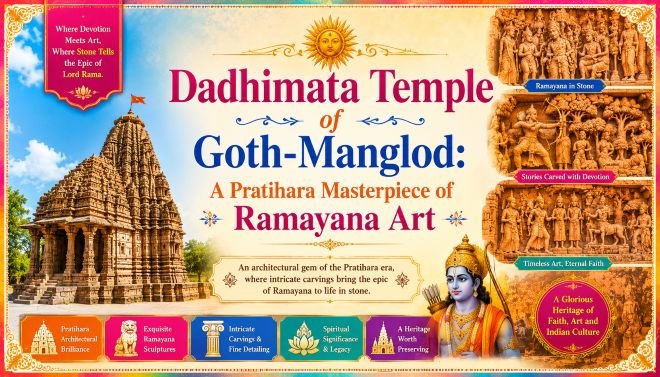
The western region of Rajasthan, especially the historic Marwar or Marumandala area, preserves a magnificent legacy of the Gurjara-Pratihara dynasty. This region is renowned for its remarkable temples, step-wells, sculptures, memorial stones, and architectural monuments that reflect the artistic brilliance of early medieval India. Among these priceless monuments, the Dadhimata Temple situated near the twin villages of Goth and Manglod in Nagaur district occupies a distinguished place.
Although the temple has long remained a living shrine and an important center of devotion for the Dahima Brahmana community, its historical significance and architectural grandeur did not receive adequate scholarly attention for many decades. Today, however, the Dadhimata Temple is increasingly recognized as one of the finest examples of early Pratihara architecture in Rajasthan.
This article explores the history, architecture, sculpture, Ramayana depictions, and cultural significance of the Dadhimata Temple while highlighting its importance in the broader context of Gurjara-Pratihara art and heritage.
Table of Contents
Gurjara-Pratihara Heritage in Rajasthan
Rajasthan possesses a rich tradition of temple architecture associated with the Gurjara-Pratihara rulers. Several scholars believe that the Pratiharas may have originated from the Bhinmal-Jalore region of Rajasthan, which explains the concentration of Pratihara monuments across the state.
Many famous Pratihara-era sites are spread throughout Rajasthan, including:
- Mandor
- Osian
- Ghatiyala
- Merta
- Didwana
- Abaneri
- Bachkala
Recent archaeological explorations by the Department of Archaeology and Museums, Rajasthan, have revealed additional monuments of immense importance. Temples such as the Makarmandi Mata Temple at Neemaj, Nakati Mata Temple near Jaipur, the Shiva Temple at Soyala, the Sun Temple at Deoka, and the L-shaped Baori at Choti Khatu demonstrate the richness of Pratihara architecture in western India.
Among all these monuments, the Dadhimata Temple stands out because of its exceptional sculptural program and its rare narrative panels illustrating scenes from the Ramayana.
Location of Dadhimata Temple
The Dadhimata Temple is located on the borders of the villages Goth and Manglod, approximately 40 kilometers northeast of Nagaur city in Rajasthan.
The temple remains an active place of worship and is dedicated to Goddess Dadhimata, who is revered as the Kuldevi (family goddess) of the Dahima Brahmanas. Devotees regularly visit the shrine for religious ceremonies and festivals.
Apart from its religious importance, the temple is an invaluable historical monument representing the mature phase of Gurjara-Pratihara temple architecture.
Historical Importance of Dadhimata Temple
The Dadhimata Temple is believed to have been constructed during the early 10th century CE. The architectural style, sculptural features, and decorative patterns strongly resemble the Pratihara temples built during the reign of King Bhoja I (c. 836–892 CE), one of the greatest rulers of the Gurjara-Pratihara dynasty.
An important inscription discovered at the temple was published by Pt. Ram Karan Asopa in Epigraphia Indica (Vol. XI, 1912). The inscription records donations made by members of a guild headed by Avighnanaga for the temple of Dadhimata.
Initially, the inscription was assigned to the Gupta Era and dated to 608 CE. However, several scholars later questioned this interpretation because Gupta Era inscriptions are extremely rare in Rajasthan. Based on palaeography and stylistic analysis, many historians now believe that the inscription may belong to the Harsha Era, corresponding approximately to 895 CE.
This revised dating aligns more accurately with the architectural and sculptural characteristics of the monument.
Architectural Layout of Dadhimata Temple
One of the most remarkable aspects of the Dadhimata Temple is that, despite later repairs and restorations, the original structure has survived substantially intact.
The temple faces east and follows the traditional Nagara style of North Indian temple architecture. Its structural plan consists of:
- Sanctum (Garbhagriha)
- Vestibule (Antarala)
- Pillared Hall (Sabhamandapa)
- Entrance Porch
The temple demonstrates a harmonious combination of simplicity and ornamental richness.
Sanctum and Doorway
The doorway of the sanctum is beautifully carved and belongs to the five-band variety, a characteristic feature of early medieval temple architecture.
The decorative elements include:
- Floral scrolls
- Interlacing designs
- Naga figures
- Amorous couples in various postures
The lintel above the doorway contains a seated multi-armed image of Goddess Durga placed in the central niche. Dancers, musicians, and garland bearers flank the goddess, enhancing the ceremonial grandeur of the composition.
The architrave also features images of Ganapati and the Saptamatrikas seated in miniature niches.
Pillared Hall and Decorative Ceilings
The hall of the temple rests upon sixteen pillars, many of which preserve their original decorative carvings.
The pillars display several classic Pratihara motifs, including:
- Kirtimukha designs
- Lotus medallions
- Geese motifs
- Creepers and floral bands
The ceilings of different sections of the temple are equally impressive. The sanctum ceiling contains a fully bloomed lotus design, symbolizing purity and divinity.
The vestibule ceiling is rectangular and divided into multiple decorative compartments filled with sculptural motifs and ornamental carvings.
These features reveal the extraordinary craftsmanship of Pratihara artisans.
Exterior Design of the Temple
The exterior of the Dadhimata Temple represents one of the finest examples of Panchratha temple architecture in Rajasthan.
The elevation consists of three principal sections:
- Basement (Adhisthana)
- Wall section (Jangha)
- Curvilinear Shikhara or spire
The temple belongs to the Nagara architectural tradition and is crowned by a large Amalaka.
Sculptural Niches
The wall section contains sculptured niches distributed across all projections.
The central projection on the rear side houses a four-armed seated image of Goddess Durga seated on a lotus pedestal.
Other niches contain:
- Parvati performing penance
- Dikpalas or guardians of directions
- Uma-Maheshvara images
- Bhairava figures
- Female attendants holding fly-whisks
The sculptural arrangement demonstrates both religious symbolism and artistic sophistication.
Ramayana Panels: The Greatest Artistic Treasure
The most extraordinary feature of the Dadhimata Temple is the narrative frieze depicting scenes from the Ramayana.
These sculptural panels are carved within broad recesses running between the Shikhara and wall portions of the temple.
The sculptor has masterfully illustrated major events from the Ramayana in fifteen large narrative panels.
The sequence begins with:
- The exile of Rama
- Rama, Sita, and Lakshmana entering the forest
- Encounters during exile
- Battles with demons
- The abduction of Sita
- Hanuman’s adventures
- The war in Lanka
- The final battle between Rama and Ravana
One of the most remarkable depictions is the sculptural representation of Ravana’s royal palace.
These Ramayana carvings are considered among the earliest known narrative representations of the epic in surviving Pratihara monuments of Rajasthan.
The detailed storytelling, emotional expression, and compositional balance of the sculptures demonstrate the high level of artistic achievement attained during the Pratihara period.
The Shikhara of Dadhimata Temple
The Shikhara of the temple remains largely intact and represents the Latina variety of Nagara spires.
Its architectural style closely resembles the early temples of Osian, another major center of Pratihara art.
The spire includes:
- Gavaksha window motifs
- Vertical projections
- Decorative miniature elements
- A crowning Amalaka
The elegance and verticality of the Shikhara contribute significantly to the monument’s visual grandeur.
Religious Significance of the Temple
The Dadhimata Temple was originally conceived as a Devi shrine and continues to function as one today.
Several features confirm its dedication to Goddess Durga or one of her forms:
- Durga image on the doorway lintel
- Main Durga sculpture in the rear niche
- Presence of Saptamatrikas
- Sculptures of Parvati and Uma-Maheshvara
The temple therefore represents an important center of Shakta worship in early medieval Rajasthan.
Even today, the shrine remains deeply connected with the religious traditions of the Dahima Brahmana community.
Contribution of Dadhimata Temple to Indian Art History
The Dadhimata Temple occupies a special place in the history of Indian temple architecture and sculpture.
Its importance can be summarized through the following features:
1. Early Pratihara Architecture
The temple is an outstanding example of mature Gurjara-Pratihara architectural style in Rajasthan.
2. Exceptional Ramayana Panels
The narrative sculptures are among the earliest surviving Ramayana depictions in Rajasthan’s temple art.
3. Sculptural Excellence
The temple demonstrates extraordinary craftsmanship in carving, iconography, and decorative design.
4. Religious Continuity
Unlike many abandoned monuments, Dadhimata Temple continues to function as a living place of worship.
5. Historical Evidence
The inscription discovered at the temple provides important information about guild patronage, temple donations, and the chronology of Pratihara art.
Why Dadhimata Temple is Important for Heritage Tourism
The Dadhimata Temple has immense potential as a heritage tourism destination in Rajasthan.
Visitors interested in:
- Ancient Indian architecture
- Temple sculpture
- Ramayana art
- Gurjara-Pratihara history
- Medieval Rajasthan
- Hindu religious traditions
will find the temple extremely valuable.
The monument also provides scholars and researchers with important material for studying the evolution of Nagara temple architecture in western India.
Conclusion
The Dadhimata Temple of Goth-Manglod is one of the hidden gems of Rajasthan’s cultural heritage. Built during the Gurjara-Pratihara period, the temple combines architectural elegance, sculptural richness, religious significance, and narrative artistry in a truly remarkable manner.
Its beautifully carved pillars, impressive Nagara Shikhara, Durga imagery, and especially the rare Ramayana panels make it one of the most important early medieval temples in Rajasthan.
The temple stands not merely as a religious monument but also as a testimony to the artistic brilliance and cultural sophistication of the Gurjara-Pratihara age.
For historians, archaeologists, devotees, and travelers alike, the Dadhimata Temple remains an extraordinary symbol of Rajasthan’s glorious architectural and spiritual tradition.
इस आलेख को आप हिन्दी में भी पढ़ सकते हैं-
दधिमती माता मंदिर : रामायण शिल्पांकन की अद्भुत धरोहर
लेखक डॉ. मोहनलाल गुप्ता राजस्थान सरकार के सूचना एवं जनसम्पर्क विभाग में उपनिदेशक रहे हैं तथा सेवानिवृत्ति के बाद राजस्थान साहित्य अकादमी की सरस्वती सभा के सदस्य भी रहे हैं।