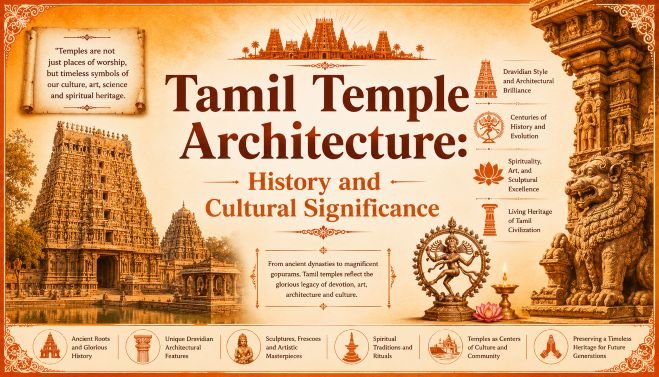
Tamil Temple Architecture is renowned for its towering gopurams, intricate stone carvings, and vast temple complexes built mainly during the Chola, Pandya, and Vijayanagara periods. Famous temples such as Brihadeeswarar Temple showcase remarkable engineering skills, detailed sculptures, and Dravidian architectural style. These temples served not only as religious centers but also as important hubs of art, education, music, and social life in South India.
Table of Contents
A temple is called ‘Alayam’, ‘Kovil’ or ‘Koyil’ in Tamil. The importance of religion in the social life of Tamils is a universally accepted fact. Since the early period, this region has been a major center of religious sentiment. Religious faith can be seen in the daily life of Tamils.
Ever since the influence of Brahminism of Hindu religion was seen in this region, a strong influence of religion has been observed here, deeply shaping the foundational elements of Tamil Temple Architecture. As a result of this influence of Hindu Brahminism, the importance of priests and worshippers started increasing in social life.
We begin to feel this from the Sangam period itself, which is about two and a half thousand years ago. But because Sangam literature was the secular literature of man and humanity, ‘secular’, therefore the importance of religion is not considered so dominant in the society of that era.
Religious consciousness was found generally among the public. Humanity was their religion. Not much faith of the public was seen towards rituals and religious deeds, which was reflected in the subsequent Bhakti era.
Religious Traditions of the Sangam Period
In the Sangam period (500 B.C. – 300 A.D.), the general form of religion was found in three ways. (i) The general form of worship-adoration of local village deities. (ii) Worship of Hindu mythological deities. (iii) Non-Hindu religious beliefs, faith, and various works corresponding to them.
These three were parallel and existed together as religious faith prevalent in the form of religion in the Sangam period, laying the spiritual groundwork for Tamil Temple Architecture.
The primitive Tamil people expressed belief in “Totem” (to’em) or clan signs. This type of practice was also found among the inhabitants of ancient Egypt. Both ancestor worship and totemic worship remained prevalent systems of worship among tribal and rural people.
This faith or belief is a matter of long before the Sangam period of two and a half thousand years ago. In the later period, tribal Tamil people, believing in nature, used to worship trees, caves, and stone blocks, long before the structured layouts of Tamil Temple Architecture emerged. They believed that God resides in trees. Then snake worship remained prevalent.
Belief in rebirth and the imagination of heaven and hell remained prevalent. Tree-worship, worship of stone blocks, water worship, worship of animals, followed by the worship of the Sun, Moon, and constellations took form. The people of ancient tribal clans had more knowledge about death rather than birth.
The fear of death kept haunting them. Belief in previous birth, worship of dead heroic men, worship of stone [‘Nadukal’ in Tamil], etc. matters are indeed thoughts related to death. They believed that every dead person definitely has a rebirth. In this way, the belief in rebirth settled in the minds of Tamils since ancient times.
Probably, the arrival of Dravidian people here had an impact on them in the subsequent era, and this impact must have been on the Aryans as well. Great faith was seen in their worship-adoration of the Banyan tree.
Therefore, the connection of a particular tree was associated with a particular deity. In the later period, when the temple culture started developing, then a practice of worship-adoration of a ‘Sthala Vriksha’ (temple tree) also became prevalent in every temple, forming an integral part of Tamil Temple Architecture.
Evolution of Deities and Integration of Beliefs
In the ‘Tolkappiyam’ grammar text, the word ‘Kadavul’ is found, which means that which is superior even to mind, speech, and action. This is considered our progressive thought regarding god-belief. This is comparable to the word ‘Brahman’ of the Upanishad.
Further, the Tolkappiyam text describes local deities like ‘Mayon’ (Tirumal = Vishnu), ‘Seyon’ (Murugan), Vendan (Indra), and Varunan (Varuna deity). Pastoral people (Ayar people in Tamil) used to worship Mayon, while hunters worshipped Seyon, farmers worshipped Indra deity, and fishermen (Bharatavar in Tamil) worshipped Varuna deity.
The mention of festivals of these various deities is also found. ‘Kotravai’ was considered the personification of the ferocity of Goddess Kali. Before going to war, worship of Goddess Kotravai used to take place. Along with all this, the practice of Sun worship and Moon worship was also prevalent. It is believed that ancient Dravidian people were Sun worshippers.
In literature, mentions of the worship of Shivji, Murugan, Tirumal, Balaraman, and Indra deity are found. Tamil people specifically used to express interest in the worship and adoration of Murugan. It is noteworthy that the names of Murugan temples are also obtained – “Tirupparankundram”, “Tiruchendur”, “Palani”, “Tiruverakam”, “Pazhamudircholai” etc.
Tamils believe that Murugan is a mountain dweller, hence all Murugan temples are located on top of hills, a core geographic feature associated with early Tamil Temple Architecture. Murugan has a ‘Danda’ (staff) in his hand.
In the subsequent era, Aryan deities also merged with these Tamil deities. Their Sanskrit naming took place, such as Murugan became Kartikeya, Tirumal converted into Vishnu, and Kotravai became Kali Parvati-Umadevi.
In later times, the work of temple construction commenced. In Tamil, many words like ‘Nagar’, ‘Kottam’, ‘Kovil’, ‘Ambalam’ etc., are prevalent for temple. The form of Shivji sitting in a meditative posture under a Banyan tree came to be known as “Dakshinamurthy”.
The worship and concept of Dakshinamurthy is found only in South India among the Dravidians and is central to the iconography of Tamil Temple Architecture. The concept of Dakshinamurthy of Shivji is not obtained in North India.
In Tamil, Dakshinamurthy is considered as ‘Alamar Devta’ (Shivji under the Banyan tree). In the epic poem ‘Manimekalai’, description of Indra deity and Indrotsav (festival of Indra) is obtained. A full description of these temples is found in the text ‘Silappadikaram’.
Brahmin people used to worship the fire deity. Mention is obtained in the text ‘Periplus’ that in Kanya Kumari, the holy ocean water of Goddess Kanya Kumari possesses the power to wash away all sins.
By the arrival of the final phase of the Sangam period, Shaivism and Kaumara (कार्तिकेय) religion had been fully established in the Tamil region. Tamil people were fundamentally Shaivites (worshippers of Shiva). Here, lingam worship-lingaopasana was an accepted practice.
Aryan people in ancient times were not supporters of lingaopasana. Among them, lingam worship or lingaopasana was a forbidden practice. Aryan people, considering the lingam as Shishnadeva, used to ignore it and even reproach it. In the subsequent period, this ancient deity of the Dravidians became accepted as an Aryan deity.
After Shaivism, the worship of Vishnu also became prevalent. Agama Shastra was composed in the Tamil region. In the eighth-ninth century A.D., scriptures regarding the rituals of worship, methods of adoration, and methods of sculpting idols of temple deities were made, standardizing the principles of Tamil Temple Architecture.
Both these rules and rituals of Hindu scriptures and the method of Agama Shastra are complementary to each other, not contradictory. Only Shramana (Jainism) and Buddhism came to be considered by Hindu people here as anti-Vedic and atheistic religions.
Both these religions were considered atheistic religions. It is a matter to be noted that both Shramana and Buddhist monks had reached South India-Tamil region from North India about three thousand years ago.
The Role of Temples in Medieval Social and Economic Life
In India, great importance has been associated with festivals and annual festivals, etc., in all religions and sects. In small and big temples, some festival or the other keeps going on every year. By the medieval period, Tamil people had become festival-oriented.
In Tamil, a festival is called ‘Vila’. The annual festival of temples is celebrated with great pomp and show for a few days. They call the annual festival “Brahmotsavam” (a Sanskrit word). In Madurai Meenakshi temple, “Chaitrotsavam”, that is Brahmotsavam, goes on continuously for ten days in the month of Chaitra.
On that occasion, the marriage festival of Goddess Meenakshi and Sundareswarar (Shiva) takes place on a large scale. To see this, rural people from nearby villages gather in large numbers in the metropolitan city of Madurai.
The entire city turns into an atmosphere of festival. This looks grand and a very captivating sight, highlighting the societal integration around the spaces of Tamil Temple Architecture. Foreign tourists also arrive to see this.
A good depiction of all these religious festivals of temples is obtained in Sangam period compositions. In these compositions, mentions of fasts, festivals, and abstinences are also obtained.
A fast is called ‘Nonbu’ in Tamil. It was a great belief of ancient Tamil people that God resides even in pillars. Based on this belief is the prevalent mythological story that Lord Narsingh appeared and gave darshan to Prahlad.
In Tamil, the saying is prevalent that “Kadavul Thunnumum Iruppar Nurumbilum Iruppar”, meaning God resides in pillars as well and in straw too. This saying is highly prevalent among Tamil people that “Koyil Illa Ooril Kudi Irukka Vendam” meaning do not reside where there is no temple.
Artistic and Multidimensional Utility of Temples
Along with religion, the importance of medieval temples is recognized in the context of art as well. Prior to the Pallava period, they did not have that form which was considered of the temples of the medieval period. In the medieval period, their splendor and glory-majesty had reached its zenith.
Just as the importance of the Church was recognized in the history of Europe in the medieval period, similarly, temples have a universally accepted important place in the social life in the history of Tamil Nadu. Temples have an inseparable nurturing relationship with the life of common people and folk culture here, solidifying the civic importance of Tamil Temple Architecture.
The economic activity of temples is also a subject worth knowing. In the medieval period, the importance of temples is accepted from three perspectives, that is, from the religious perspective, from the perspective of artistic beauty, and from the perspective of social-economic relations, thus from the moral, spiritual, aesthetic, and utility perspectives.
The temples of the Tamil region have their own system of prayer-worship-adoration and rules and rituals too. Due to the prevalence of temple-construction art, sculpture, idol-making art, painting, music, dance, drama, etc., in the premises and courtyards of temples, the utility and importance of temples also increased.
They also have various types of worldly activities. For the sake of various types of services, various types of people used to be appointed – keeping accounts in its small role of economic business, tax collection, arrangement of general meetings, running schools, arrangement of medical care, arrangement of giving food charity to the poor and hungry, and sometimes the assembly for dispensing justice, for the sake of multiple worldly activities, the temple was utilized.
Kings-emperors, wealthy merchant people used to be the protectors and nourishers of these temples, who gave their contribution by giving wealth in the form of charity for the sake of proper arrangement of temples. Therefore, it would not be correct to understand the temple merely as a holy place of worship-prayer.
It is considered a complex social, religious, and economic institution, reflecting the majestic scale of Tamil Temple Architecture. To understand it from an historical perspective, it would be proper to assess its importance and its glory in the correct perspective.
After the reign of the Pallavas, after the ninth century, the special construction work of temples commenced. In the era of the Chola dynasty, the temple construction work specifically kept increasing. In the same manner, its expansion took place in the period of Pandyan kings as well.
On many occasions of wars, the victorious king used to obtain wealth etc., like gold, silver, diamonds, and jewelry in sufficient quantity from the defeated king. All this obtained wealth used to be deposited in the treasury of the royal palace.
All this wealth was not spent for the sake of erasing the poverty of the poor from an economic perspective, or it was not spent for the sake of raising the standard of living of the general public. Such thoughts did not even arise in the minds of the kings-emperors of that era; the property obtained as loot in war used to be deposited in the royal treasury and that was considered the personal property of the king.
Its utilization used to be for the people of the royal family, commanders of the army, courtiers, followed by distribution among poets and temples. Sometimes, a little arrangement was made for the general public as well.
In this way, the major part of the immense wealth that was in the royal treasury was utilized in the works of temple construction. The thought of erasing poverty did not arise in the minds of those rulers at all. Merely by doing charity, religious deeds, and rituals, they used to feel content. For this reason, poverty could not be completely erased from society.
Only from time to time, some relief was given to the poor, just that much. In a way, that medieval society operated in the form of a charitable society. Kings did not have any effective plan to erase poverty and to raise the standard of living of the public.
If the wealth had been applied in productive works, there would have been an increase in it and the public would have been prosperous from an economic perspective too. But it did not happen so. The religious mindset of common people and the mentality of conforming to the rights of the official class remained maintained among the people.
As a result of that very thing, scarcity remained maintained in society from an economic perspective. If the additional wealth had been utilized with the objective of raising the standard of living of common people, the social life of Tamils would have become better, but it did not happen so.
The temples of deities were considered like the royal palaces of kings-emperors. They also used to call the royal palace ‘Koyil’ (temple) in Tamil. Just as the deity of the temple was looked upon with sentiments of reverence-respect and his service was done with the same reverence, similarly, the mentality of accepting the king with respect-honor and reverent sentiments was built up. In this way, the tradition of the worship of ‘Devaraja’ commenced.
Tamil Temple Architecture: Layout and Internal Traditions
In the medieval period, the worship in the temple used to be individual. The system of collective and community prayer was never prevalent here. The priest performs his separate duty, and the praying devotee people separately.
If desired, the service of the priest can be taken for performing worship, but that is not an mandatory condition. Even without the priest, the devotee can pray standing with devotion before the archamurthi (consecrated idol) of God.
Principally, the temple is not a place for spiritual thinking, sacrificial-ritualistic deeds, or Vedic debate or discussion, but there is no restriction for doing such work there either. The devotee has a direct contact with God. In this way, the devotee and the priest are independent of each other.
In the middle part of the temple, right in the center, the garbhagriha (sanctum sanctorum) is built in which the idol of the deity remains established. Around the outside of the garbhagriha, in the corridor or mandapam all around, devotee people circumambulate, observing the spatial layout defining Tamil Temple Architecture.
On coming out of the temple, outside the gopuram (entrance gateway) of the temple, shops remain spread out just as seen in a shopping center. Inside the big mandapam of the temple, religious discourses, mythological storytelling, and programs of bhajan groups go on.
The gopuram of the temple is the entrance gateway. It is very massive and high. Gopurams remain built on all four sides of the temple. In big cities like Madurai etc., gopurams are built up to a height of 200 feet. It is a large, airy, and open compound.
Madurai Meenakshi temple has an interesting and special tradition. In the medieval period, the kings here used to govern the state considering themselves as representatives of Goddess Meenakshi.
Every day, the king would come inside the temple for darshan, and placing his scepter and sword with devotion at the lotus feet of the grand idol of Meenakshi, only after obtaining the blessings of the Goddess, he conducted the management of the state in the name of Goddess Meenakshi.
This tradition has been coming down through ages. Even in the time of Thirumalai Nayak, the ruler of Madurai, this practice remained prevalent. The wealth that was deposited in the hundi (donation box) of the temple was utilized in the management of the temple and applied in works of public welfare. This practice, this tradition, has been coming down continuously unbroken till date.
The kings-emperors of the Tamil region were public-spirited, benevolent, and ego-less rulers. Nowhere in Tamil history is a mention of a tyrannical king obtained. Therefore, there has been no oppressive, cruel ruler or absolute king here. History bears witness to this fact.
All works of the temple proceed following the rules and rituals method of Agama Shastra. Entry of devotee people inside the garbhagriha (sanctum sanctorum) is forbidden. Standing outside the garbhagriha, there is a tradition of having darshan from a distance.
Only the priest can enter inside the garbhagriha. He alone can bathe the established and consecrated idol of God, does its decoration with new attire, can adorn it with ornaments, can put a flower garland on it, and can perform the aarti.
A high-level committee is formed for the sake of the management of the temple, and under its guidance, the works of the temple proceed smoothly.
In the medieval period, the Devadasi system was prevalent in temples. They were dedicated maidens, virgins, for the sake of the service of God. They were considered as devakanyas (heavenly maidens). They were skilled in fine arts like dance, singing, etc.
In front of the idol of the deity, their programs of singing, dancing, etc., used to take place. For other types of services of the temple as well, their services used to be taken. Such as bringing water from the well, wiping the floor, making rangoli, making flower garlands, etc., many types of services used to be taken from them.
In course of time, flaws started entering this practice. History says that this type of Devadasi practice was prevalent in Sumer (Sumeria). When the Dravidian people, moving from there, reached this region, they also popularized this practice here along with them.
The temple was never considered a sanctuary (Sanctuary) as happens in the Western church. Within Hinduism, the temple maintained a principal place in society. Tamil culture is temple culture. It is considered a temple-centered culture.
The temple is considered a non-Aryan and non-Vedic (Non-Aryan and non-Vedic) institution. This culture of Dravidians started becoming prevalent in other parts as well in later eras.
The Tamil literary context, references, etc., of about 1800 years tell us about the temples here. Ancient Tamil people gave special attention to the arrangement of temple construction. Evidences regarding their religious works from 700 A.D. to 1600 A.D. are available even today, chronicling the durability of Tamil Temple Architecture.
Chronological Development of Tamil Temple Architecture
Leaving aside the cave-temples (Cave temples) of the Pallava period of the ancient era, the temples of the remaining subsequent period are constructed in accordance with the method of Agama Shastra.
The architecture of temples constructed in accordance with the rules and rituals of Agama Shastra is almost uniform. Yet, some individuality and distinctiveness is reflected in them. Three types of art were prevalent.
One style of North India, second Deccan (Deccan) style, and third South Indian style which is considered the Tamil people’s own style. This is considered Dravidian architecture by experts. Commencing around the seventh century, it remained prevalent until the thirteenth-fourteenth century.
In Sangam literature (the period from 500 B.C. to 200 A.D. is called the Sangam era), we get good information regarding temple construction. In that era, temples constructed of bricks, mortar, lime, and wood were found.
On its prototype itself, specimens of temples made of stone blocks are found in the subsequent era. Among these, gopurams (entrance gateways) built in the shape of a conch used to be very massive and high. In the upper part of the garbhagriha, a circular gopuram is built.
Large and high chariots of wood are built. On the occasions of festivals and functions, idols of deities made in punchdhatu (five-metals) were established in the mandapam in the middle of those chariots, and taking them out of the temple, they were taken in a procession all around on the massive wide roads.
The gopuram of a temple refers to the external entrance gateway. The custom of building large and high gopurams was prevalent. Built many centuries ago, the temples of Tamil Nadu even today stand with pride, displaying their glory and majesty.
Till date, no obstacle has come in their stability and strength. To know and understand the architectural skill of the Tamils, it will be necessary to visit these massive, sky-scraping temples.
In the past fourteen-fifteen centuries, sufficient development and progress is reflected in the art and skill of temple-construction. In its course of development, we perceive five stages of Tamil Temple Architecture –
1. Cave temples constructed during the reign of Pallava or Pandya kings, which belong to the seventh century.
2. Structural masonry temples of the period of Pallavas and Pandya kings.
3. Temples of the Chola period type with a single central gopuram.
4. High and lofty temples of the gopuram type, equipped with multiple entrance gates, belonging to the reign of Pandya kings.
5. Temples of the style of Vijayanagara rulers of modern style.
In between, general changes took place in the construction of temples, which are not so important.
Key Dynastic Transitions and Monumental Creations
A major change is perceived from the beginning of the seventh century. Without bringing change in its prototype and method, this change was observed. The change was in such a way that instead of brick, mortar, lime, and wood, stone blocks started being used.
From the eighth and ninth century, important changes are reflected in the architecture of this type of temples. The ‘Mandagapattu inscription’ of the seventh-century Pallava ruler Mahendravarman tells us that cave temples are pure stone temples built by them without brick, mortar, lime, wood, or iron.
Therefore, Mahendravarman was given the title of ‘Vichitra Chitta’. This will be considered a remarkable change in temple construction art and skill, altering the historical trajectory of Tamil Temple Architecture.
Through the medium of a single monolithic (monolithic) stone block, multiple temples of stone were constructed by his son Narasimhavarman Pallava (First). This art was already known to the Badami Chalukyas. Therefore, the Pallavas used that new art for the construction of temples here.
Within a century itself, Pandya kings got cave temples built in this very style. In this way, gradual changes were perceived in temple-construction art, and thus the craftsmanship of the artisans of the Tamil region is reflected in building construction and temple construction art.
The Brihadisvara Temple of Thanjavur, which is called Thanjai Peruvudaiyar Koyil in Tamil, presents the finest specimen of the temple art and skill of construction. So massive that it rises high, tearing and cutting through the clouds of the sky, such a gigantic temple and sky-scraping gopuram you will not find anywhere else in Tamil Nadu.
This was constructed during the time of the Chola Emperor Rajaraja Cholan (985–1014 A.D.). The Shiva-lingam of the garbhagriha of this temple is about eighteen feet high. Right in front of the garbhagriha, in the huge courtyard outside, an idol of Nandi made from a single massive stone block is consecrated in a reclining posture, displaying its grandeur, which is the main attraction for visitors.
The height of the gopuram built on the upper part of the middle portion of the garbhagriha is 200 feet. Probably, this is considered the highest and grandest temple of Tamil Nadu, a milestone in the trajectory of Tamil Temple Architecture.
A similar other grand and splendid temple was got constructed by his son Rajendra Cholan at Gangaikonda Cholapuram. Which even today stands displaying its grandeur, vastness, and artistic beauty. The glory and majesty of Tamil Nadu is indeed due to this type of its grand and gigantic temples. The Tamil land is a land of temples; Tamil culture is fundamentally a temple-centered culture.
The next stage of development of temple construction-art is considered to be of the period of the famous Pandya kings. The feature of their temple-construction art lies in the fact that high and lofty gopurams are built in all four directions of the temple, which along with being high, are also wide and massive entrance gates.
In the Meenakshi temple of Madurai and the Sri Ranganathaswamy temple of Srirangam too, four massive and high entrance gates (gopurams) are found built in all four directions in the same manner as obtained in Madurai, capturing the scale characteristic of later Tamil Temple Architecture.
These high and gigantic grand gopurams display their solemnity and artistic beauty. High ‘Vimanam’ is built above the mandapam of the garbhagriha, which remains covered with gold sheets.
A similar construction is found in the Nataraja temple of Chidambaram too. In the huge courtyard inside the temple, huge extensive high mandapams are built, the utilization of which is done for many types of religious works.
After the Vijayanagara rulers, the Nayak kings displayed special interest in the expansion of temples and in the works of their renovation. The gigantic huge mandapam of a thousand pillars and the ‘Kalyana Mandapam’ are considered features of these temples.
In that era, works of temple construction attracted the attention of artistry towards various other types of construction works. The palace built by Thirumalai Nayak of Madurai and the Maratha rulers of Thanjavur is wonderful. The forts and bastions of Gingee, Arcot: Vandavasi, Vellore, Namakkal, Dindigul even today stand with pride, displaying their importance.
The wonderful murals, artworks, idols, countless inscriptions, copper plates of the temples of Tamil Nadu provide us wonderful information and details. For those interested in these, these temples are wonderful treasuries. Not only in India, these temples do not have their equal across the world.
In short, from the study of the course of development of temples of the Tamil region, it becomes clear that they have an inseparable nurturing relationship with the life of common people and folk culture here. Today, even in this materialistic and scientific age, the people here continue to respect this monumental heritage, ensuring that the legacy of Tamil Temple Architecture continues to be preserved by their descendants.
आप इस आलेख को हिन्दी में भी पढ़ सकते हैं-